
LTS regularly researches and reviews emerging educational technologies. We test, review, gather feedback from faculty and students, and make recommendations about which technologies to adopt on a wider scale based on this research. We strive to provide up-to-date and effective technologies to improve the learning experience and support student learning outcomes.
Our key considerations include:
Meeting teaching goals: How well does the technology support effective instruction?
Usability: Is the technology easy for instructors and students to use?
Accessibility: Can all users access and benefit from the technology?
Support: Are resources available to help instructors and students use the technology successfully?
Redundancy: Do we already fund and support a tool that performs the same or similar functions?
Privacy and Security: Is the tool FERPA compliant and is our data secure?
Value: Is the technology worth the cost?
Course Site Upgrades
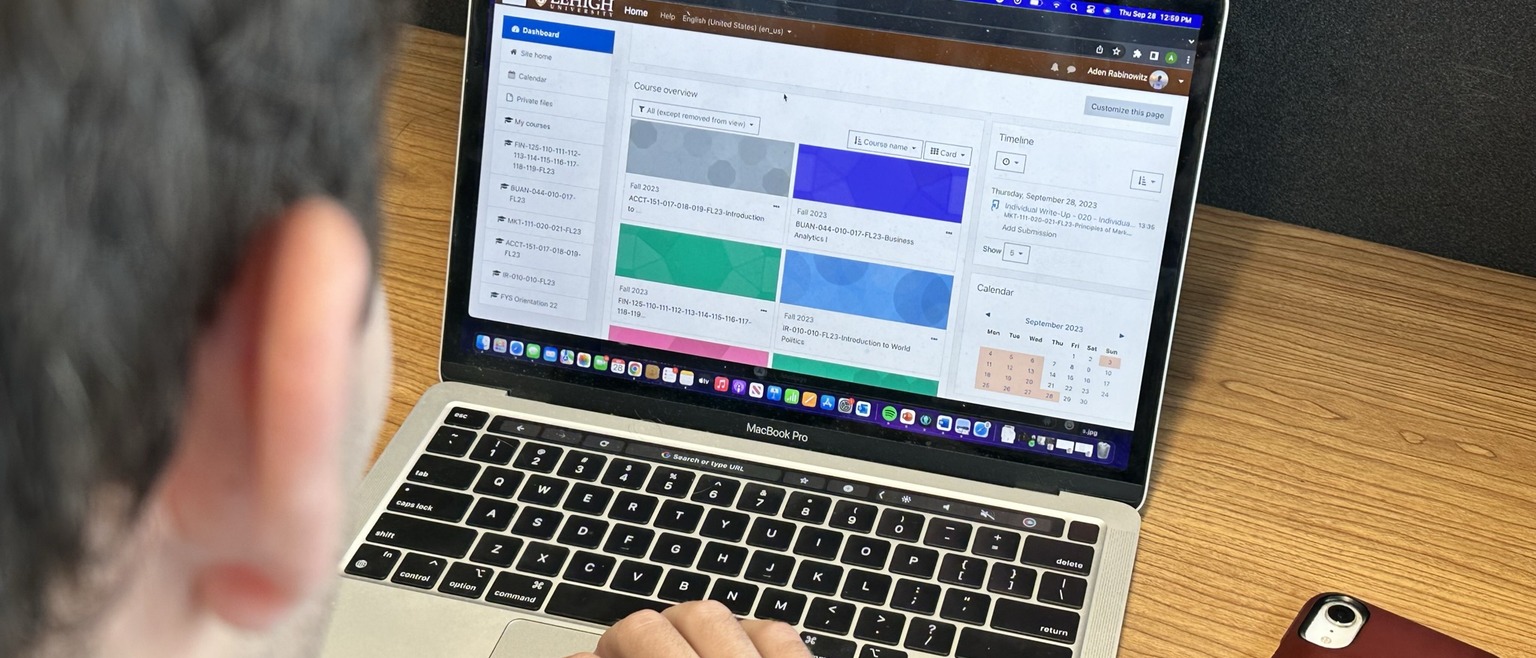
The instructional technology team upgraded Course Site from Moodle 4.5 to Moodle 5.1 this summer. This upgrade includes several enhancements.
- Updated purpose-based categories for adding activities and resources to your course.
- Activities tab in the main horizontal navigation bar at the top of your course listing every active task in the course in one view.
- The ability to add subsections to better organize course content within a topic.
- A new rich text editor called TinyMCE.
- A new Zoom Integration that allows you to create and share Zoom meetings within Course Site.
- A new Panopto integration that allows embedded quiz grades to pass to Course Site gradebook.
This winter, we will begin an evaluation of the AI subsystem available in Moodle 5.1.
Recent Evaluation Projects
To foster real-time student engagement and participation in large lectures, the Center for Innovation in Teaching and Learning (CITL) has evaluated multiple polling tools—including Socrative, Slido, Kahoot, Mentimeter, and Google Forms—based on audience capacity, Lehigh credential login, mobile ease of use, cost, and presentation integration. While Poll Everywhere successfully met these needs and became a staple for limited academic licensing, CITL is now piloting a new polling tool called Wooclap. Unlike previous options, Wooclap features a license structure that would more cost-effectively allow for full, university-wide adoption, potentially expanding seamless interactive learning tools to the entire campus community.
Gradescope was piloted in 2022 and adopted in 2023, and was a collaboration with the Math department, which was looking for a less labor-intensive way to collect and grade handwritten work. Gradescope was integrated into Course Site, allowing grades to be easily communicated and written work to be quickly digitized by either the student or the professor. Gradescope is now used by several departments and is particularly useful for large classes to review student work anonymously, by problem collections, regrade all at once, and standardize feedback and rubrics among graders. Gradescope also provides a self-grading solution for bubble test sheets.
There currently is not an LTS-supported lockdown browser. We did use Responus Lockdown during the pandemic but found that the cost, lack of strong vendor support, and recurring technical issues for students were not sustainable. As an alternative, we can offer the following resources related to promoting academic integrity in assessments, including ideas for assessment creation and recommended quiz settings:
- Online Assessment Best Practices
- Best Practices for Course Site Quizzes: Promoting Learning while Maintaining Academic Integrity: Best Practices for Course Site Quizzes: Promoting Learning while Maintaining Academic Integrity
- Another option could be discussing proctored exam options with the Testing Center. More information on proctored exams is available here: How to Request a Proctored Exam | Student Affairs
We have researched some new tools, such as HonorLock, Octoproctor, and Trifecta, to serve this purpose, but have not found a solution.
We are currently testing ExamSpace. LUapps (Apporto’s) ExamSpace is a secure, browser-based virtual environment that locks down student access to only approved tools and resources during various assessments such as a course site quiz.
Google Jamboards have been widely adopted in classrooms and Zoom sessions as an interactive collaborative tool, but Google has stopped supporting this tool. LTS is researching and testing alternatives such as Zoom whiteboards, Figjam, Miro, Jira, and Microsoft whiteboards.
The CITL is currently piloting Zoom Video Management (ZVM). ZVM is an add-on tool that helps organize recorded Zoom lectures, webinars, and presentations into a video library. ZVM automatically groups recordings into course-specific channels and can use AI to generate transcripts, summaries, and searchable chapters. Students and faculty can locate specific academic content, integrated directly within Course Site, and ZVM provides control over viewing permissions and analytics across campus.
During the 2023 spring and fall semesters, instructors had access to the Turnitin AI detection tool as part of the university's ongoing license. Beginning in the spring of 2024, Turnitin required a separate license to access this AI detection functionality. LTS evaluated Turnitin’s AI content checker, was wary of false positives, and decided not to pursue the add-on. We are actively monitoring and researching the efficacy of AI detection tools, most recently Copyleaks, and will continue to reevaluate them as improvements are made.
Curio is an open XR application that leverages virtual and mixed reality to enhance tutoring, study groups, self-guided learning, or full classroom lessons. It offers both a library of instructor created content as well as a platform for developers to create custom content. Formerly known as CurioXR, Curio has emerged as a primary source for providing continued support and access to both research funded and student developed legacy XR content. Beginning in the summer of 2026, the LETs Lab hosts Curio on its fleet of Meta Quest headsets and offers it for evaluation and use to the Lehigh community as we collaborate with Curio on needs and assessment.
CITL is at the early stages of a pilot of Tyto, an online platform for building pedagogically sound game-based learning experiences. As interest in game-based learning and game studies in higher education increases, we are investigating both digital tools and physical resources for both creating an learning to add to the toolbox of students and faculty. Tyto has long been used by professional Instructional Designers to develop digital games for the classroom and industry. Lehigh becomes one of the first institutions to put Tyto into the hands of students for classroom use and evaluation.
CITL is also researching and supporting the open-source platform Twine in a few pilot courses. Twine is an interactive narrative platform that classes can use to showcase writing in a different modality. Twine can be enhanced by CSS and JavaScript, but can be used with zero prior coding knowledge. Twine has the ability for students to create branching paths/narratives, can be enhanced with multimedia, and is output to a single html file.
CITL is evaluating the usability and effectiveness of H5P to enhance interactive course content through Course Site. H5P is an open-source platform that is built into Course Site, it has over 50 different content types including interactive video, formative assessments tools, course review activities, immersive content, game-based learning elements and more.